Building the AI troubleshooting framework for 5 million point-of-sale devices
Orbit (name changed to protect client privacy) has provided over 5 million point-of-sale devices worldwide to a variety of merchants: the handheld a server brings to your table, the omnipresent tablet-style register at shops, delis, and cafes.
When one of those devices acts up, almost everything currently runs through a call to support.

The ask
Orbit wanted merchants to be able to troubleshoot and even replace their own devices. This process included two distinct pieces:
Troubleshooting
Guiding users through common actions like reset the device, press a button, check a setting. Today it only happens on a call with support, working from guides merchants never see.
Diagnostics
Hardware tests that run on the device itself. Engineers ran them on returned devices back at the factory. Orbit wanted merchants running the same tests before a device ships, as the gate that confirms something is actually wrong.
The KPI limbo
170–200K
calls to support a year to process 60–80K device replacements
That’s two to three calls per merchant around every replacement. Most of the calls after the first are about tracking a device they’ve already sent back.
- 38%No trouble found
- 12%Physical damage
- 8%Tampered with
- 6%Liquid damage
- 4%LCD scratched or damaged
- 4%Chip reader not working
- 3%Won’t power on
So we had two goals: reduce calls to customer support, and reduce the number of devices replaced with nothing wrong with them. These goals were often at odds with each other.
Let more merchants replace devices themselves and calls go down, but take the human out and it gets a lot easier to replace a device that’s fine. Almost every screen came back to the same question: how do we keep this easy enough that a merchant doesn’t give up and call, but just strenuous enough to avoid an onslaught of unnecessary replacements?
Building the symptoms-to-issues framework
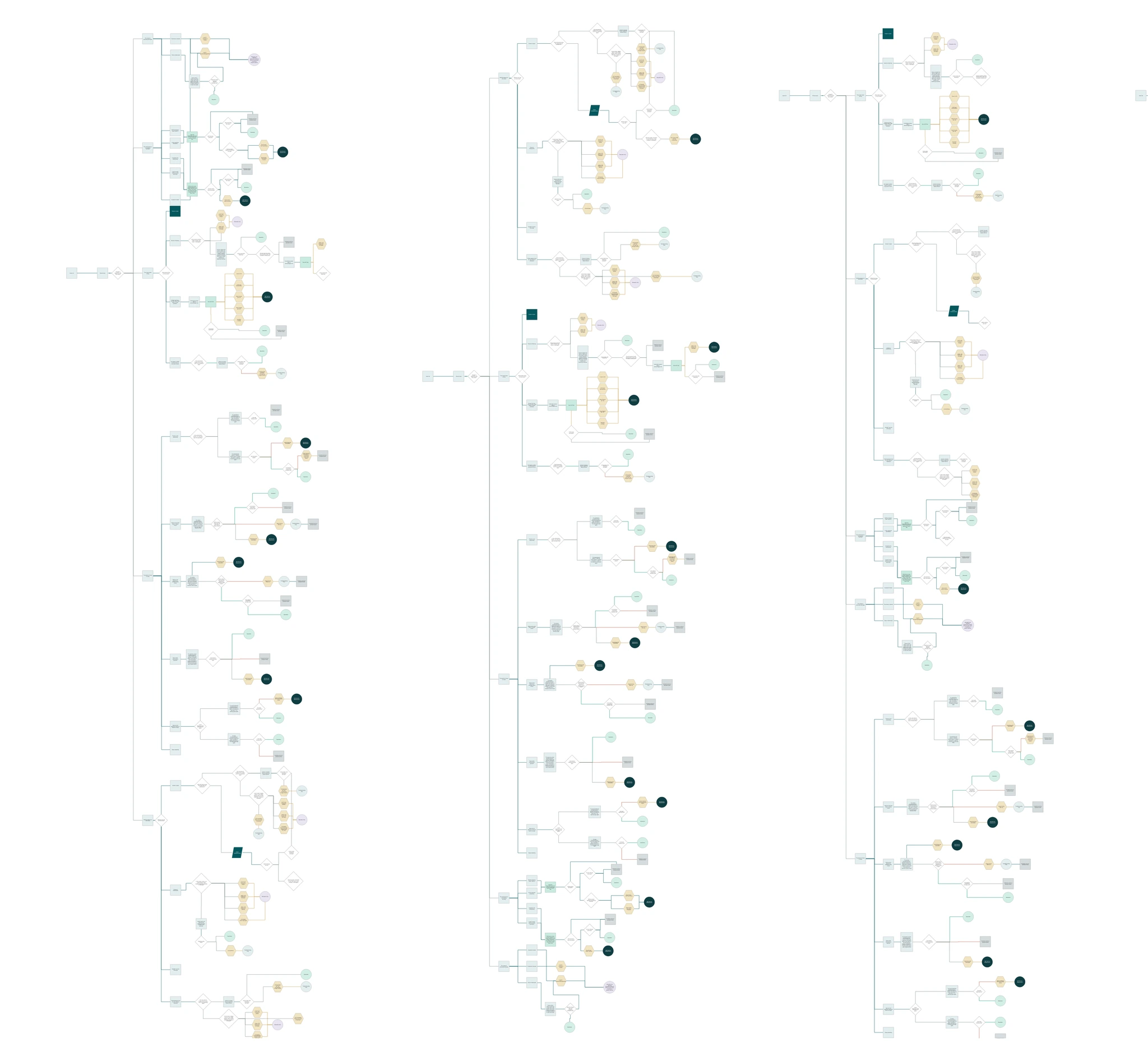
Orbit already knew why devices failed. It had a list of hardware failure classifications and the rules for which ones qualified for a replacement. What nobody had modeled was how a merchant comes in. Merchants describe symptoms, not failures, and without knowing how they’d describe a problem, there was no way to build an experience for them. So the first thing I led the team to do was build that framework: symptoms to issues.
We pulled from every source we could get:
- Customer support’s troubleshooting guides, which were basic and incomplete.
- The hardware failure classifications, worked backwards. We had AI research common point-of-sale hardware problems and list the symptoms a merchant would actually notice for each one.
- Thousands of real support calls. An AI agent analyzed them for how merchants described their problems, what agents asked, which steps they tried in which order, and what actually helped.
That gave us enough to draft a framework, but I built the maps themselves by hand, branch by branch. The AI’s versions were often redundant, too tedious, or just not how a merchant thinks, so I rewrote a lot of them. I also made sure a merchant didn’t have to get it right the first time. Someone with a screen problem might pick power, or an accessory, and still end up in the right place. It’s a bit like a hospital: you walk in with a headache, and nobody expects you to say it’s your gallbladder.
We mapped screen and power issues in this much depth, then paused there so we could move on to shaping the experience and development could get started. The maps were always meant to keep growing over time.
A templated, node-based flow
Mapping the screen issues and power issues flows allowed me to identify clear building blocks of the experience (for example, sometimes a step buried in a support guide worked better as a question, because it sorted people more accurately or led somewhere more useful, so I turned it into one). Once I’d been through enough of the maps to trust that anything in this experience could become one of these pieces, I built one non-linear, multi-node template that could transform into any possible flow for this experience.
Every merchant starts by choosing the device and the problem. From there, an issue can move between conditional questioning, instructional guidance, and/or running hardware tests in any order, until it ends in education, a handoff to support, or a replacement.
The support handoff mattered a lot, because it meant the experience could launch before every branch was solved.
Training Nova, Orbit’s AI assistant
The same framework runs troubleshooting inside Nova, Orbit’s AI assistant. Nova uses our maps to decide what it asks next, troubleshooting guidance, and when to hand off to a hardware test or a human customer service rep.
- Choose deviceNova asks which device, then matches “one of the compacts” to the merchant’s own devices.
- Conditional questioningPhysical damage or liquid first. That’s a different branch of the map, with a different outcome.
- TroubleshootingThe map’s first fix for a flickering screen: restart.
- Troubleshooting, adaptedThe merchant already restarted three times. Nova moves to the next fix on the map instead of repeating itself.
- Hardware test gateRestart and power are ruled out, so the map says test the screen. Nova launches the test on the device itself.
Making the maps machine-readable
We started with traditional content matrices in spreadsheets, identifying the dynamic content across the screens and built matrices for it. The next step was turning every box on the map into structured content, in a platform like Contentful, so the guided flow, Nova, the help center and support tools all read from one source.
Nova handles the conversation while querying the graph for every next step. Its advice matches the guided flow and what support would say, and fixing a step once fixes it everywhere.
Learning from every session
Machine learning does some heavy lifting here in matching a merchant’s words to a symptom. The support calls we analyzed are its starting data, and every session after that makes both the matching and the maps a little sharper.
- 1 · Merchant
“My screen’s acting weird”
- 2 · Intent matching
A machine-learning model matches the words to a symptom
- The screen looks wrong
- Nothing appears on the screen
- The touchscreen isn’t working correctly
- 3 · Nova follows the map
- “What looks wrong on the screen?”
- Flickering → restart
- Still flickering → screen test
- 4 · Result logged
- Screen test failed
- Replacement, no call
The guided flow
We worked on this experience with the aim that merchants would never feel the complexity beneath it. Rather than asking merchants to explain what’s wrong, the experience asks them simple questions, worded the way they would describe the problem themselves. Each answer determines the next question, so we only ask what we need to narrow things down, and there’s always an option to tap instead of a blank box to type into. Shown here is one example of a path, from selecting a device to qualifying for a replacement.
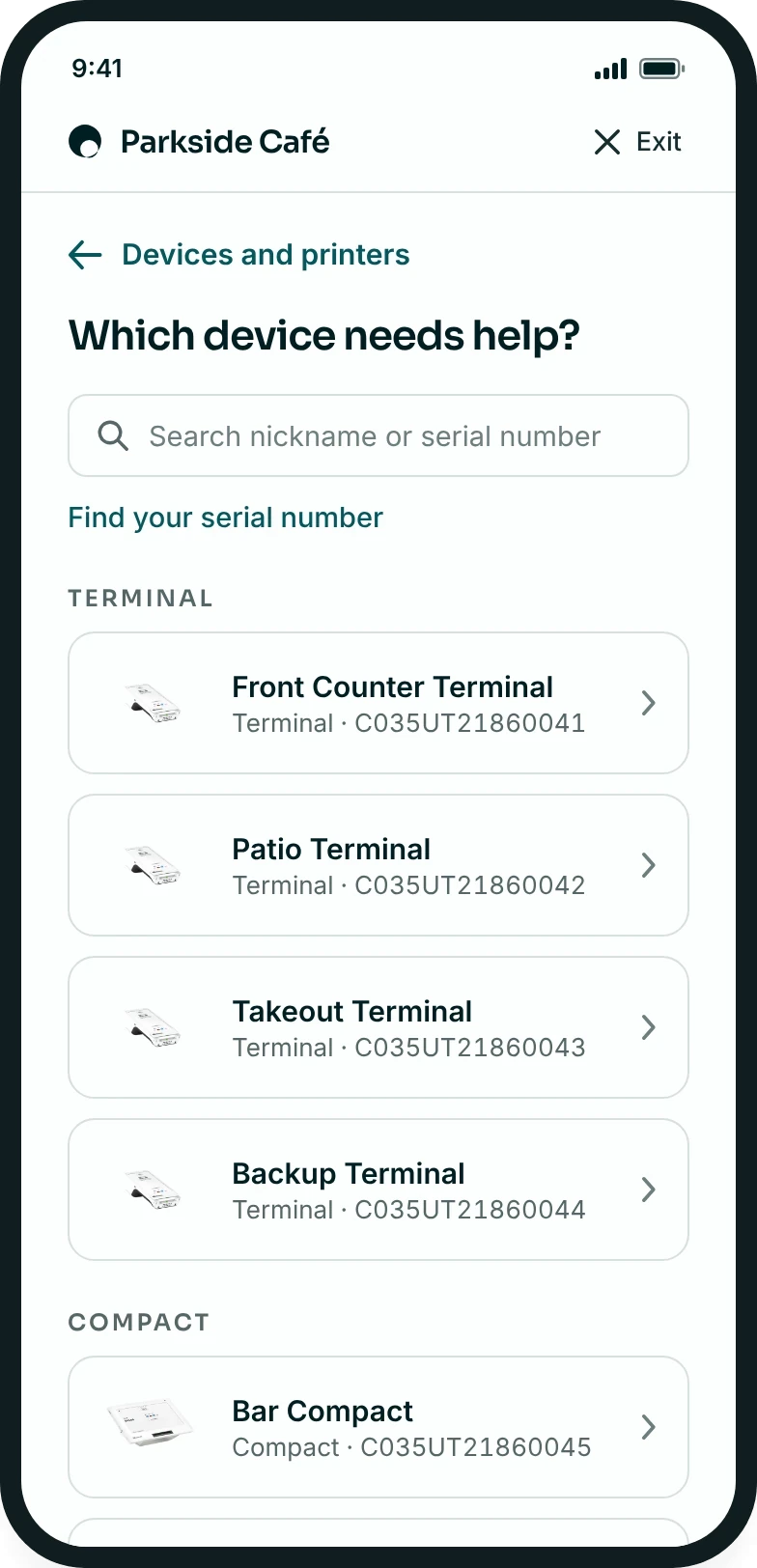 01Device select
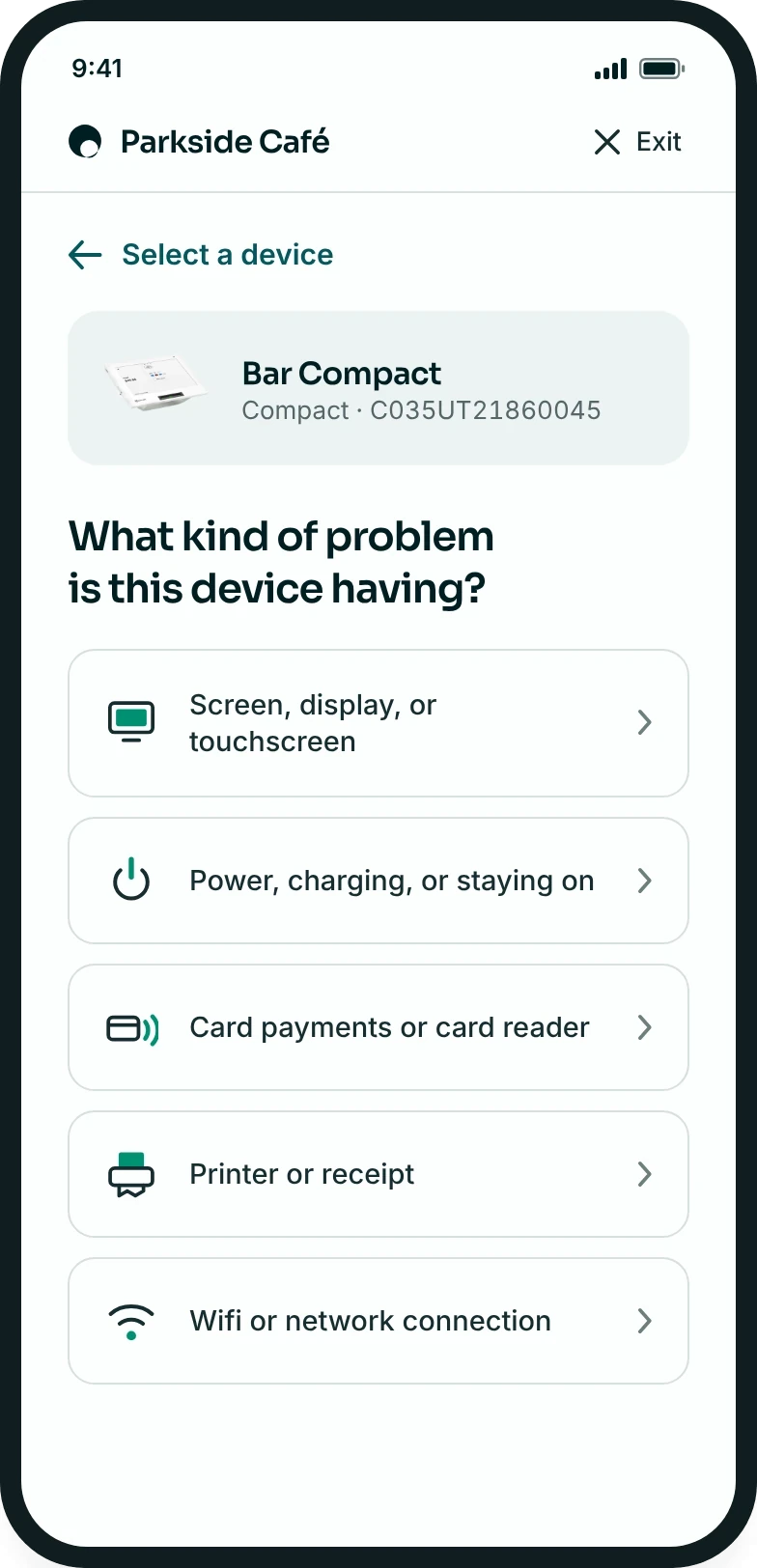 02Issue category
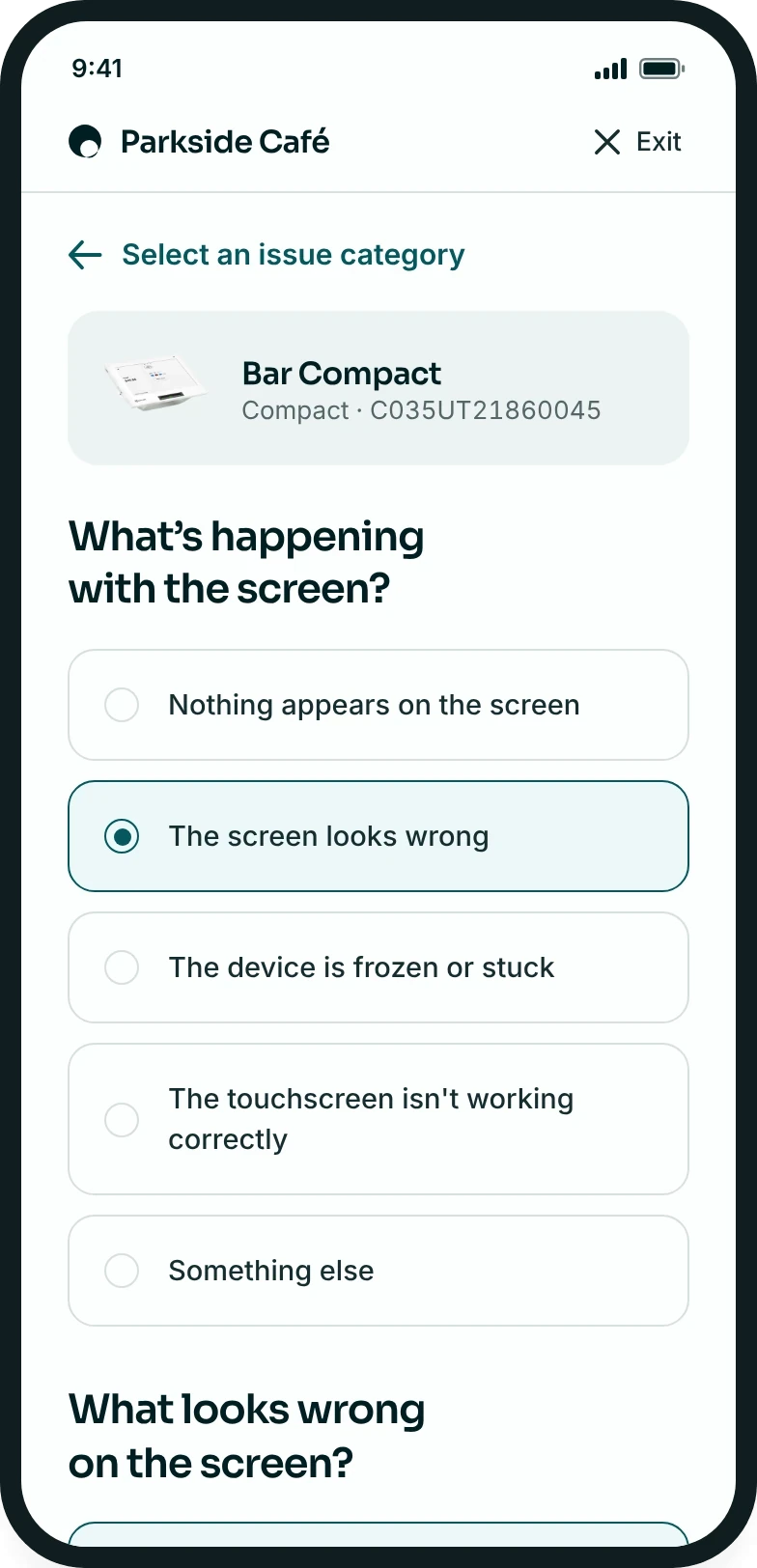 03Symptom questions
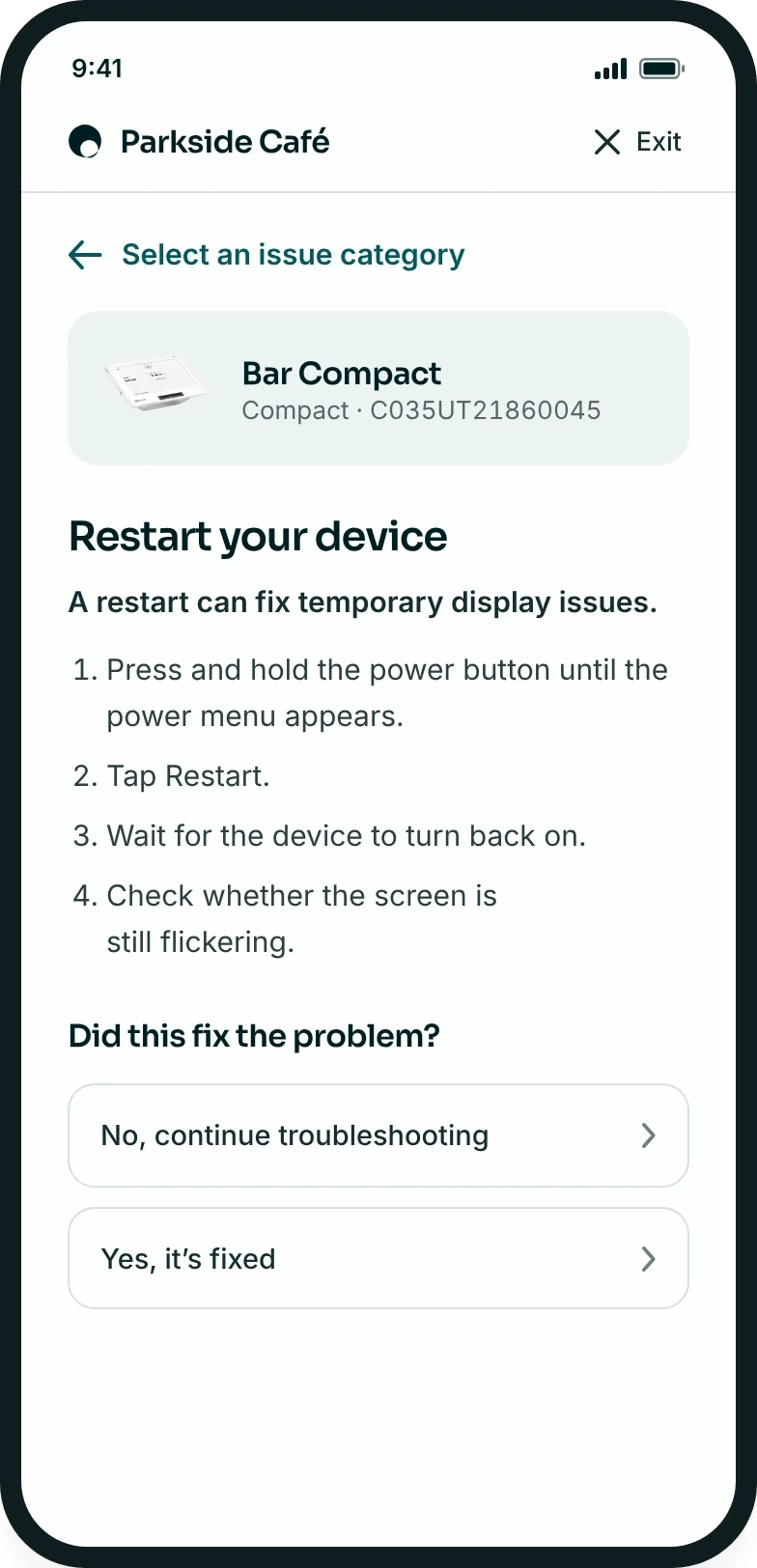 04Guided fix
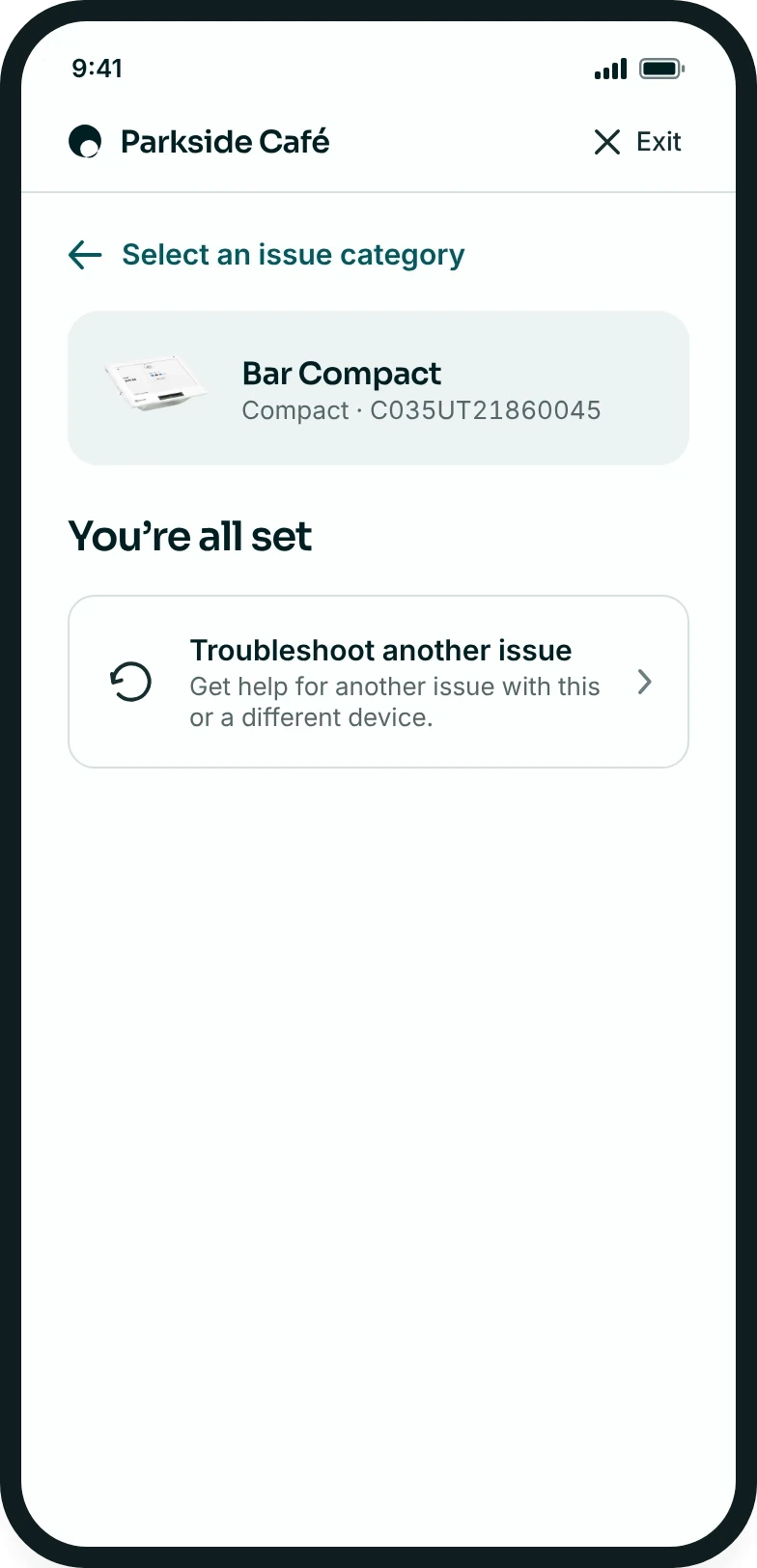 05Issue fixed
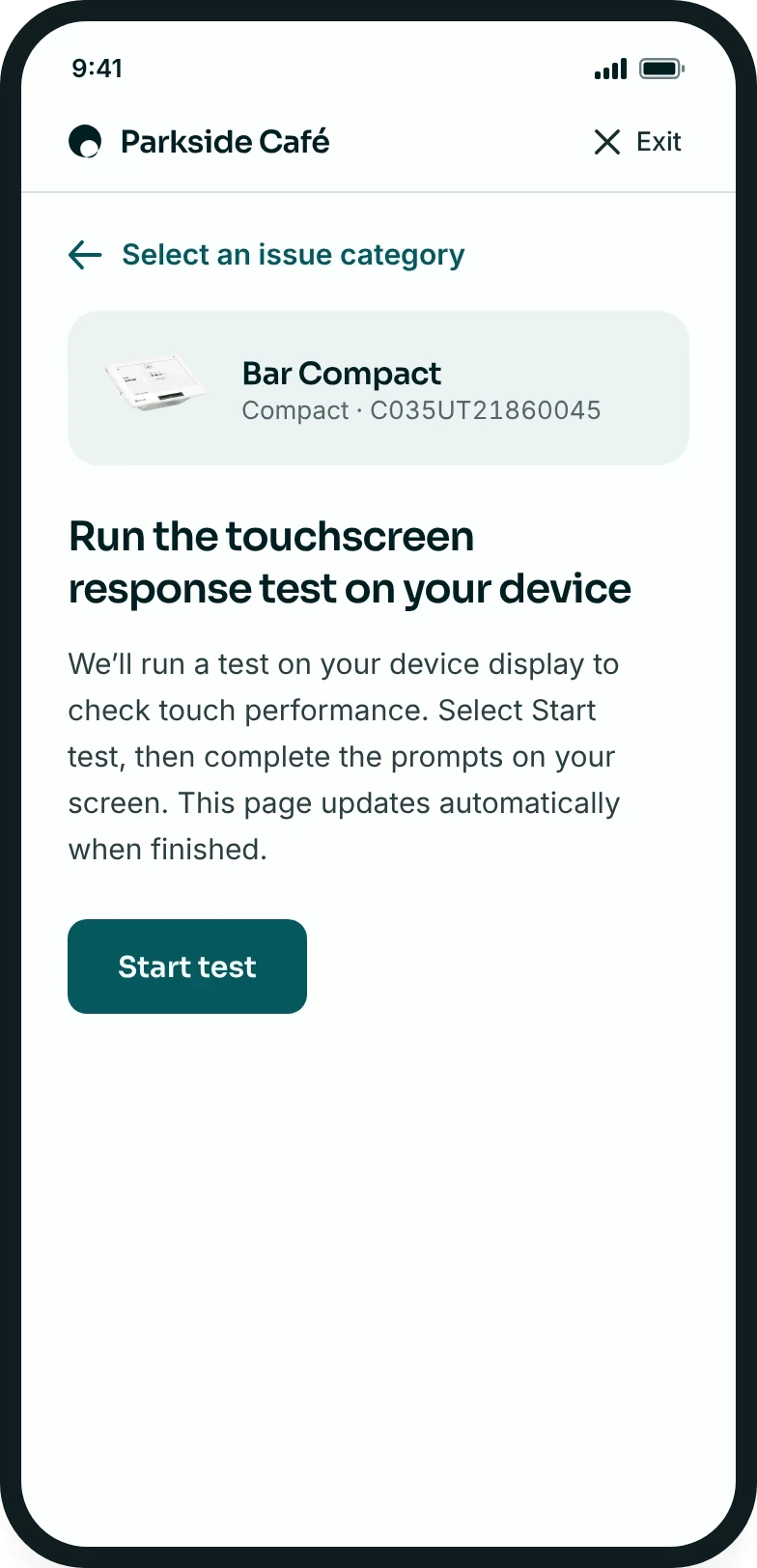 06Hardware test
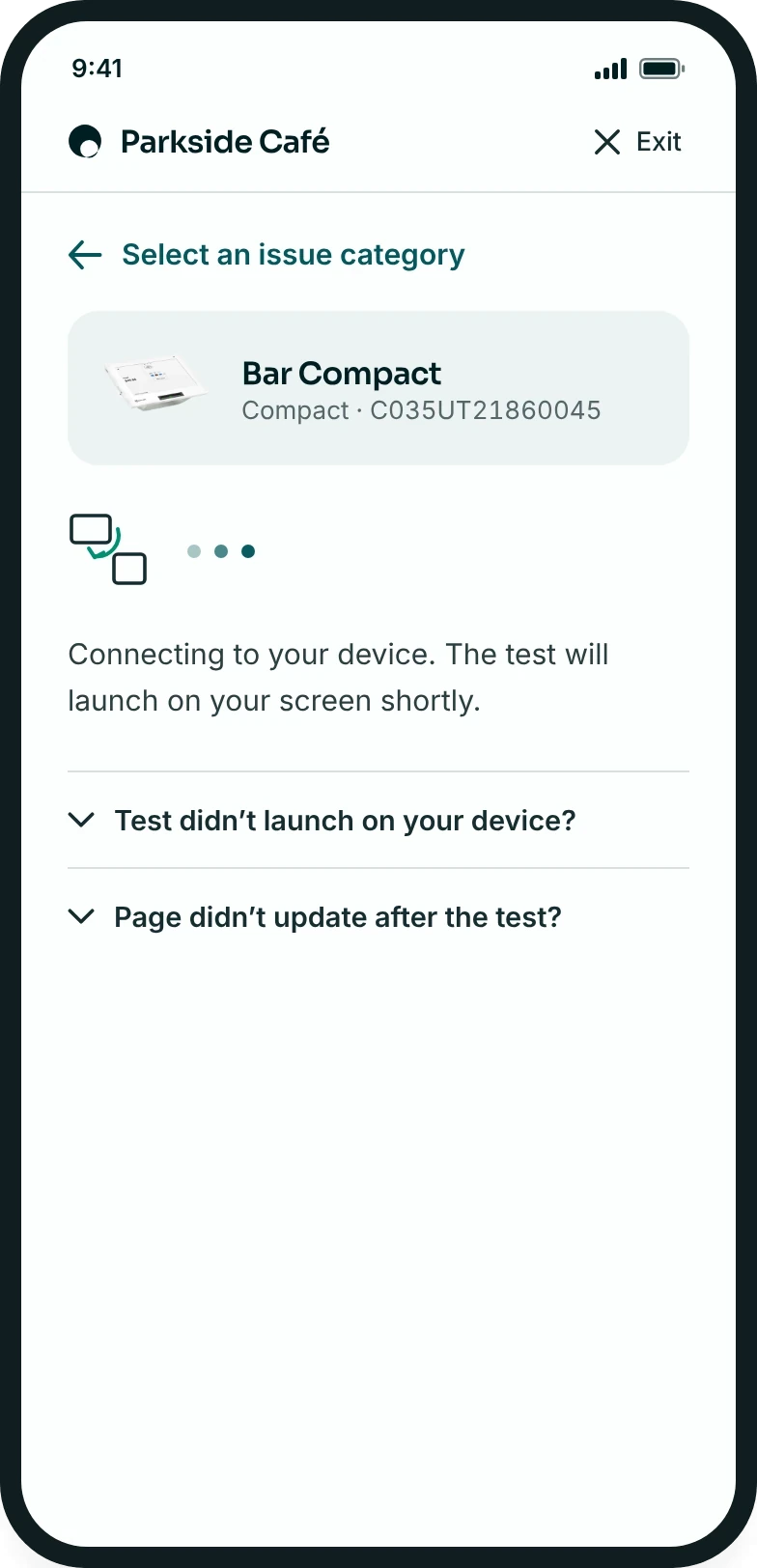 07Test launching
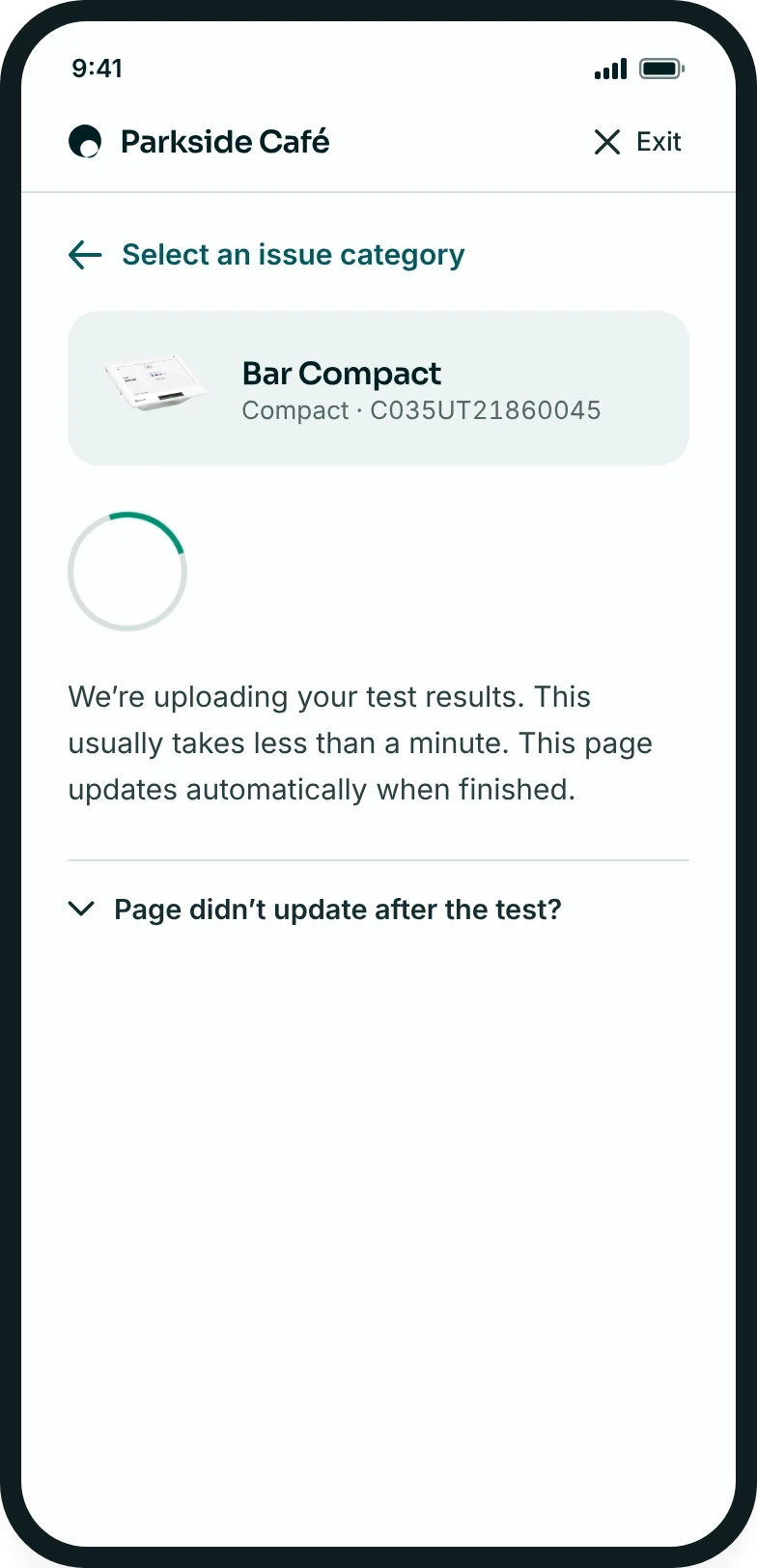 08Uploading results
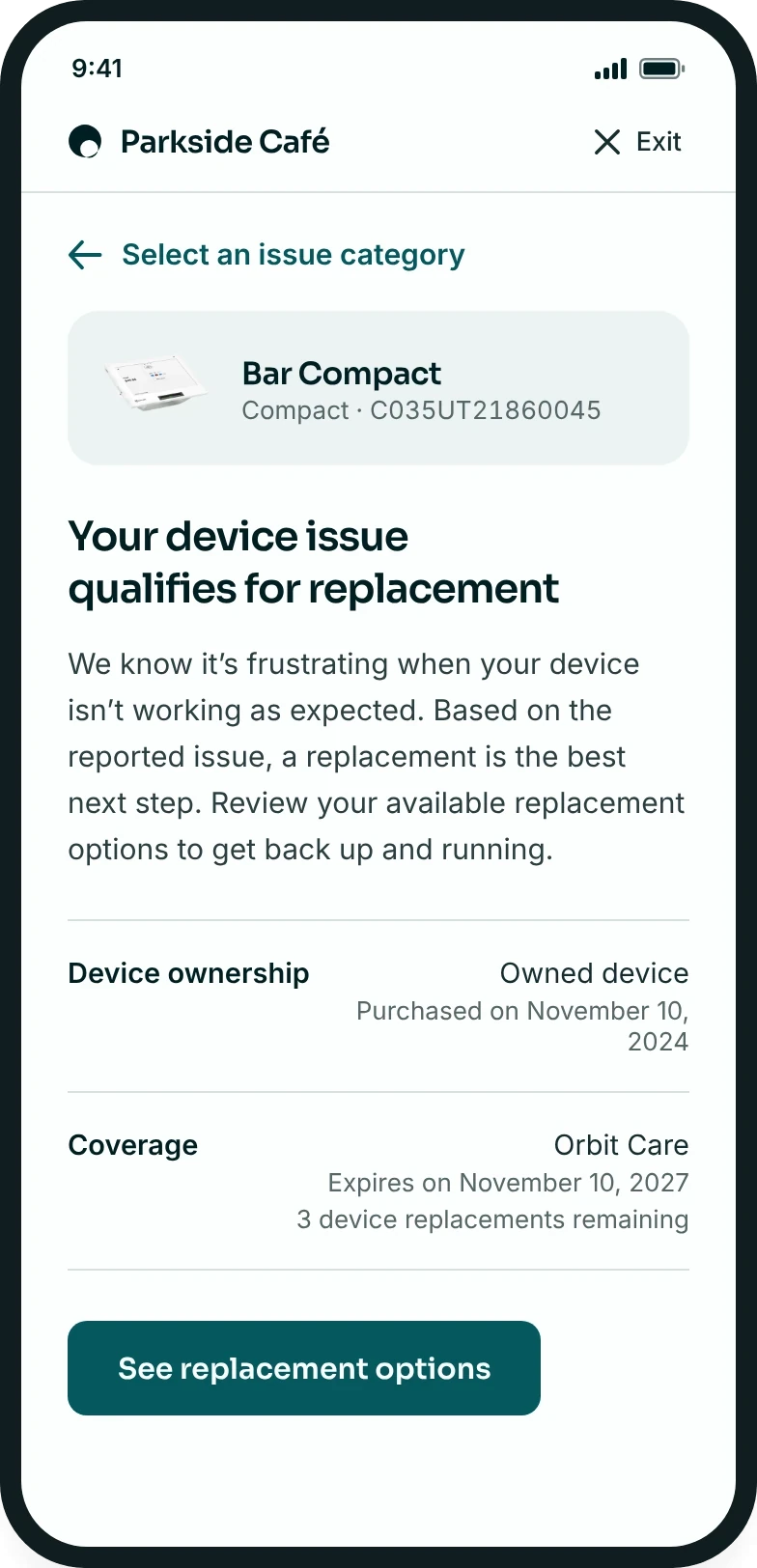 09Replacement eligibility
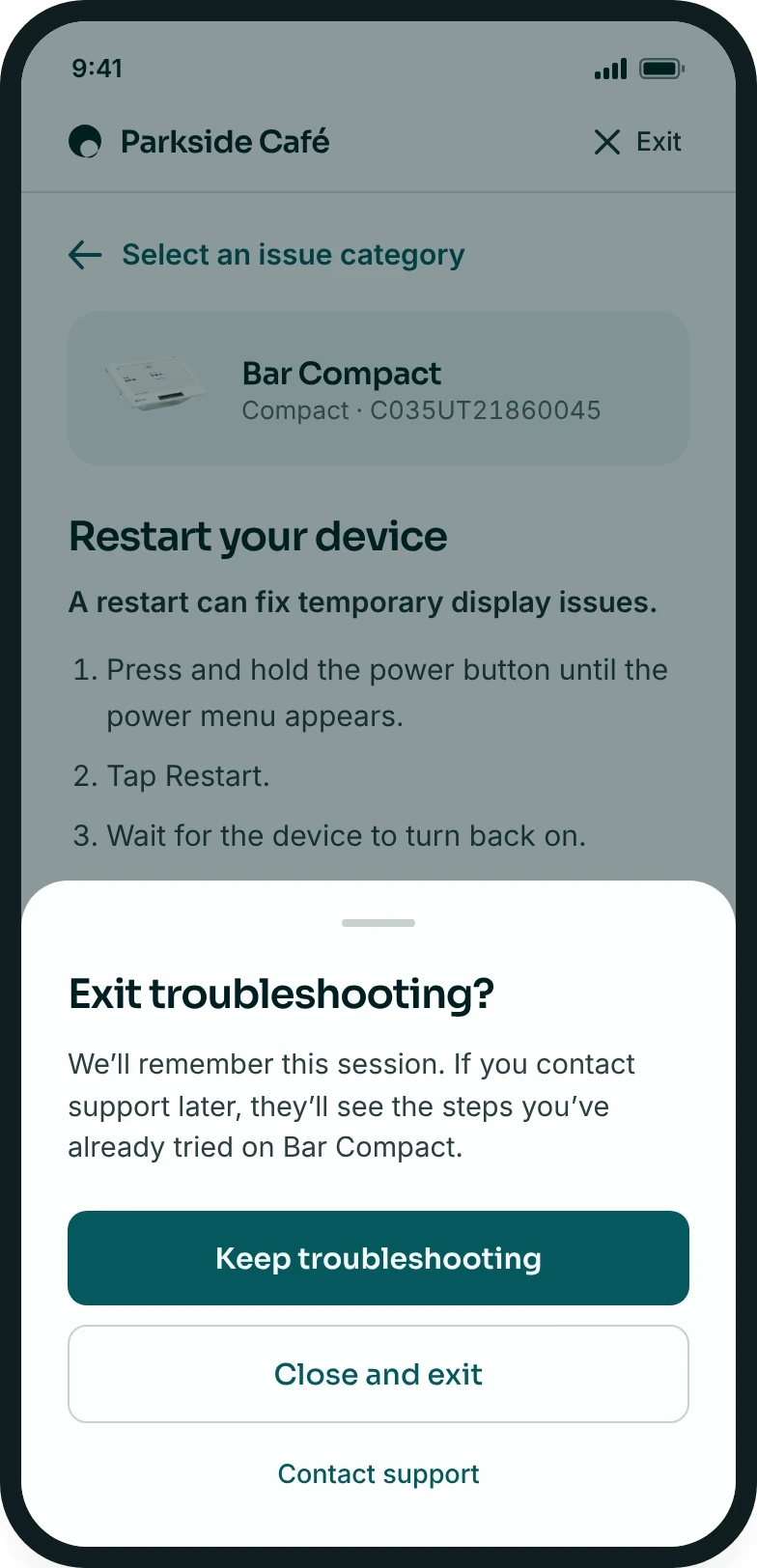 10Exit confirmation
Research insight
Most merchants preferred the guided flow. Open-ended conversation felt like more work.
At one point, our team asked whether we should only build the chat experience. So we tested Nova against the guided flow, and surprisingly, the guided flow won out. We took that result with some caution, since you can’t perfectly simulate a real AI conversation in a prototype. Still, merchants told us they liked having the experience guide them and put the words in their mouth, rather than having to decide what to type and how to describe the problem. Many also had some baggage from years of interacting with unhelpful chatbots. The research gave us the evidence to keep investing in both experiences.
Hardware tests
We were told the hardware tests already existed and mostly ran on their own, but in reality, they lived in a hidden engineer mode, were never meant for merchants, and almost all of them required heavy user interaction (think having a user swipe a card, draw a line, report on the appearance of a color).
We had to completely examine and redesign all of these tests (without having time scoped out for it) before we asked users to interact with any of them.
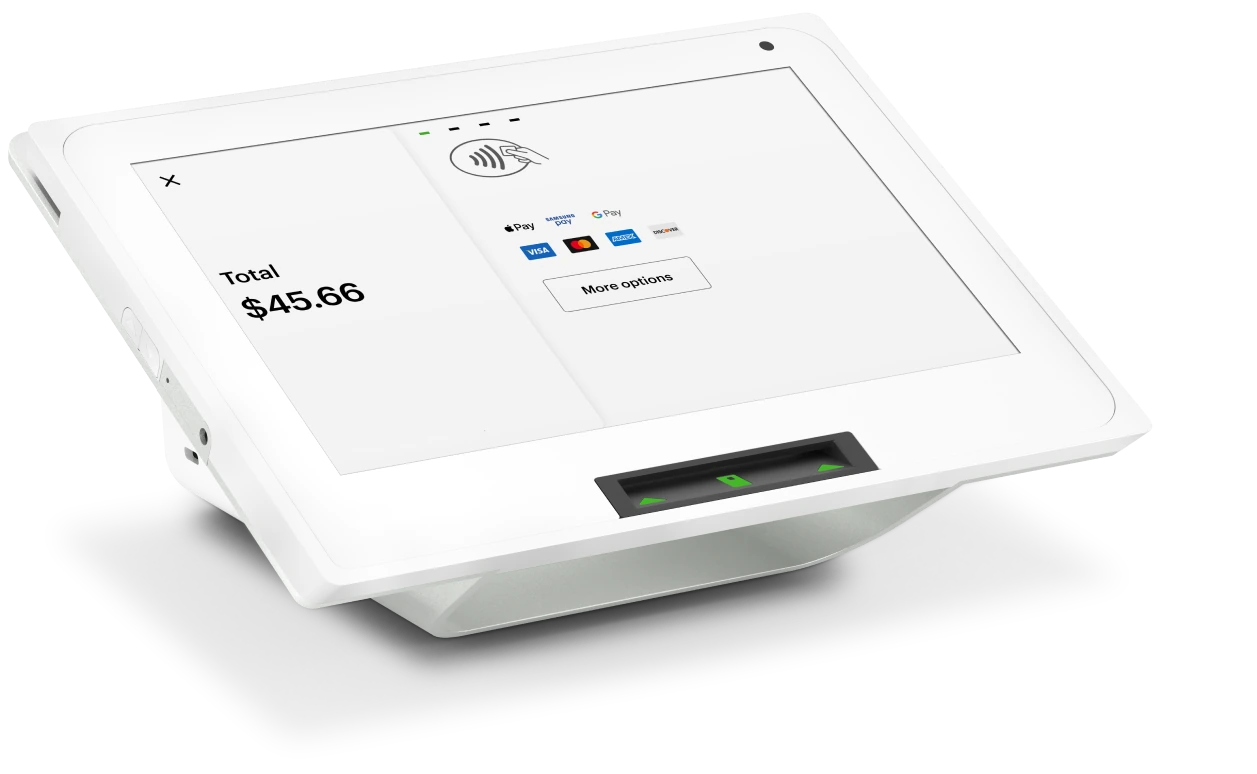
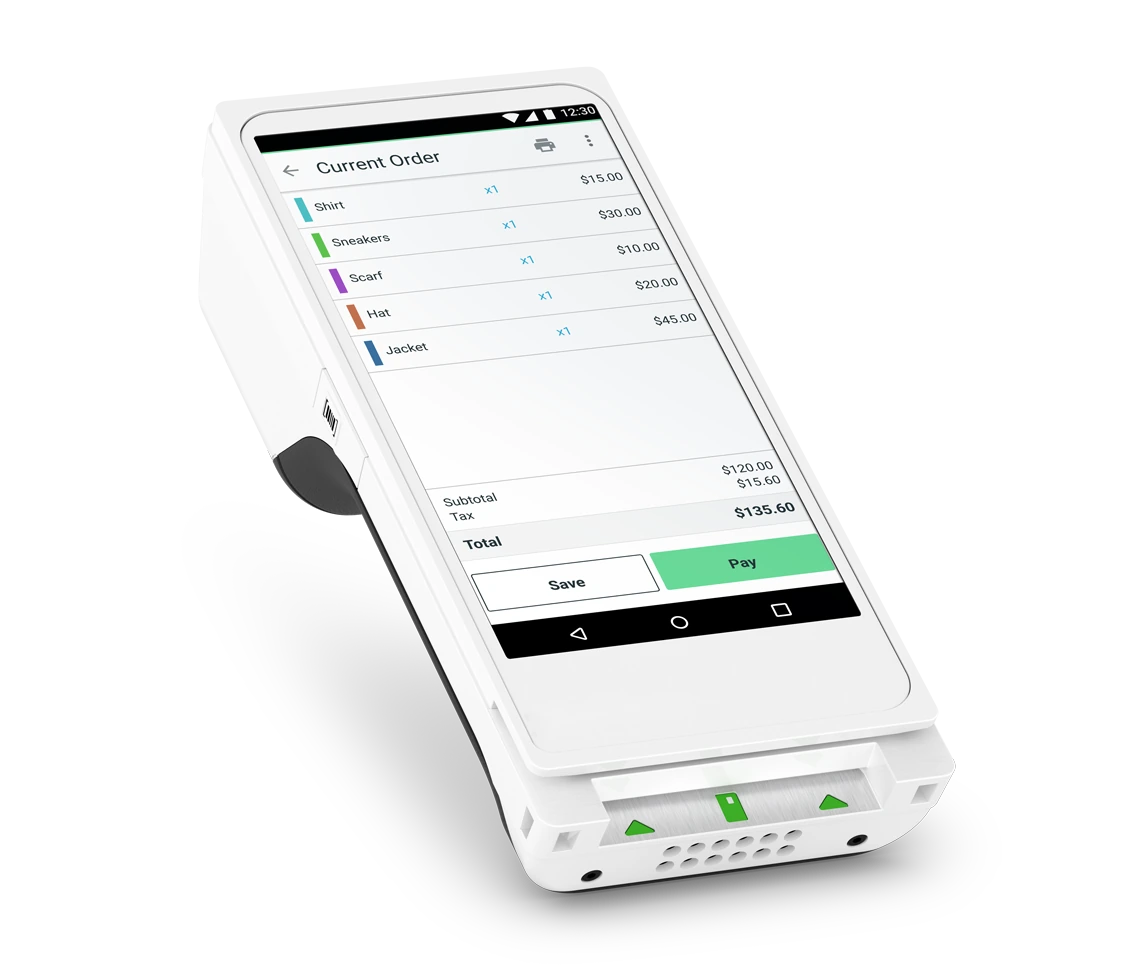
Here we faced a major conundrum: for most tests, it was impossible to tell the difference between hardware failure and user error. For example, if you open the card reader test and do nothing, it defaults to registering as a failure.
The touchscreen test was the trickiest: stay inside a narrow lane, and lift your finger and you fail. So every test was designed to fail, retry, and recover, and we built working prototypes to feel what passing and failing were actually like.
The outcome
We went in expecting support to hand us a troubleshooting process we could turn into self-service. What we found were pieces of one, spread across customer support, hardware engineering, documentation and individual teams, often not aligned.
The core of this project was really service design — defining the actual process behind an experience.
The maps went to subject-matter experts in customer support, software and hardware engineering for review, and became a shared model of how device problems get diagnosed. Orbit’s teams and AI experiences can now work from the same model.
We also hope and expect this new model will drastically reduce the 38% of returned devices that come back to Orbit with nothing wrong.
Note: This experience is currently being built, so there are no results to share yet. Orbit chose to launch quickly, knowing that early on it would likely mean replacing some devices that didn’t need it. We flagged that risk along the way, along with accessibility issues we found. Because errors lean in the merchant’s favor, we didn’t push too hard against the timeline, and I designed the experience to launch fast and keep improving.
We still expect it to move both goals. Merchants will have troubleshooting and guidance that didn’t exist for them before, support becomes the fallback instead of the first stop, and support and hardware teams are more aligned on how to troubleshoot.
“Orbit” and “Nova” are stand-in names. The client’s real name and visual branding have been changed, and some UI details edited, for privacy. The research, structure, and design decisions shown are real.