Discovering a direct-to-consumer product for a world-famous golf company
The Titleist Performance Institute (TPI) – a B2B sector of the renowned American golf company Titleist – enlisted my team at Endava to capture the consumer market. Over 9 weeks, we created a validated MVP that will bring their elite golfer performance institute to a market of golfers ready and willing to become customers.
The Client
The Titleist Performance Institute
Engagement
Product Discovery
January - May 2024
Role
Design & Strategy Lead
Background
The Titleist Performance Institute (TPI) is the pioneer of the “Body-Swing Connection,” a unique methodology that allows golfers to improve their swing through fitness. TPI had developed a strong B2B business, primarily offering an array of certification programs to fitness instructors, golf coaches, and physical therapists.
The Goal
TPI was looking to build a consumer-facing business that could bring their science-backed methodology and training program directly to golfers.
Our Challenge
Awareness Despite both the brand recognition of Titleist and the awareness of TPI amongst industry professionals, almost no golfers knew of TPI’s existence.
Breadth of Work TPI leaders wanted to investigate every possibility — everything from franchising to industrial design tech — before diving into assuming a digital product would be ideal.
Complexity & Knowledge We had just nine weeks to gain a deep understanding of the mechanics and logic of TPI’s methodology (which existed solely in the minds of its founders) in order to adequately translate it into something meaningful.
Focus Create something that balances the many needs & desires of modern golfers while envisioning a cohesive product that the company can actually build.
We also had to learn a lot more about golf.
The Outcome
By the end of this short engagement, we had discovered and created an MVP concept that we are sure will be adopted by thousands of golfers.
Our validated concept compelled the Titleist executive team to sign on for a 3-5 year duration, $10 million engagement with Endava to build it within a few weeks after we completed this engagement.
How We Did it
Identifying pillars
Based on the identified challenges in the market, we determined that all features in the envisioned app should fulfill the following pillars:
Guided
Make it feel effortless -- simplify the complex science behind TPI to keep golfers continuously engaged across the Titleist ecosystem.
Trusted
Become the golfer’s north star, a source of truth they can turn to for all golf-related education and instruction, with an emphasis on science.
Curated
Cut through the noise in the industry with rich content philosophical consistency, and personalized guidance.
Measurable
Provide tangible results that golfers can see and feel both on and off the course, rewarding their engagement with measurable outcomes.
User Interviews
We hosted two dozen 30-minute sessions with golfers and TPI-certified fitness & medical professionals to give ourselves a strong foundation of knowledge and empathy for our target users.
Key Learnings
1
TPI products should co-brand with their parent company.
Golf consumer awareness TPI was scant, even amongst the most avid Titleist customers. And the ones who had interacted with TPI didn’t distinguish it from Titleist. So, any consumer-facing TPI products should co-brand with their parent company.
2
Human touch points are currently the most effective tools in golf improvement
Consistency is key to success in golf training, and touch points with TPI professionals are key to consistency. This means our product should serve golfers the way touch points with professional golf and fitness coaches do.
3
Stay out of the sensors & equipment market for now
Most golfers use a variety of apps and tech for golf, however, nearly half of golfers we spoke to have stopped using even the most popular ones due to issues such as battery life, unhelpful data, and unwieldy UI. This helped us realize that going into the sensors & equipment market would be the wrong opportunity fit for TPI, given how clearly difficult it is to get right even for companies who focus and specialize on them.
Overall, we learned the best opportunities for TPI lay in its parent company’s brand, and bringing its niche in-person program to a digital platform, where it could provide much-asked-for personalized golf fitness instruction, therapeutic touch points.
Identifying Opportunities
Now that we had a very wide (albeit shallow) perspective of the goings-on in the golf world, we needed to move towards turning our learnings into potential product features and consumer services.
As a Golfer, I Need…
In our first ideation session, we translated what we had heard in interviews into “As a golfer, I need..” statements.

Clustering
Our need statements allowed us to approach to begin ideating on features with empathy and purpose

Building & testing a high-fidelity concept
Looking at all we had, we began placing our features into an eco-system via sketching and low-fidelity design work. Meanwhile, we continued building hypotheses about which features held the most value to golfers and why.
After a couple short rounds of design iteration, we recruited 12 golfers to participate in 75-minute, one-on-one sessions, where we conducted an interview alongside a concept prototype.
(Side note: I’ve omitted it here, but I love collaborative research planning and would be glad to walk through my processes for anyone interested).
In tandem with user testing sessions, we sent out a survey to 3,345 golfers engaged with the Titleist brand to gain additional insights.
Overarching Questions
While each feature and screen has its own target findings, we sought answers to the biggest, glaring questions that would validate the economic success of a TPI product:
Will golfers use this product? Is this worth making?
What makes this product valuable or unique to golfers? Which features make or break its success?
What is the product’s worth in monetary value? How much should we charge for this, in which type of pay structure?
Onboarding
We had to immediately collect information about golfers to get them started on a meaningful experience. We created a dozen or so screens that asked golfers about the activity level, golf experience, health, performance and goals.

Key Research Questions
Does the onboarding process feel relevant and expected for golfers?
Does the experience -- or any specific parts of it -- feel tedious or difficult?
Are there any circumstances where a golfer may abandon this process?
100% of the golfers in testing sessions said they were glad to undertake a lengthy onboarding process, and in fact appreciated that it signaled a more personalized experience.
However, golfers said it would be helpful to be as prepared as possible for the time commitment when taking into account the assessments. A few key intro screens before onboarding ease any convenience issues, and golfers are able to pause and come back to the onboarding process.
Golfers expect their responses to directly inform the output – which they (rightly) assumed would include a regimen that would help them improve their golf game.
Our biggest concerns around the assessments were whether golfers felt capable conducting them -- especially the swing analysis, which requires them to film themselves.
Fortunately, all testing participants said they would be comfortable performing both the physical assessments and swing analysis. In fact, 91% said they already routinely film their golf swing for personal use.
Physical Assessment & Swing Analysis
As an extension of Onboarding, we needed to physically assess golfers the same way TPI does during its in-person sessions -- capturing key mobility metrics as well as their golf swing.

Key Research Questions
Do golfers understand these assessments and why they are being asked to perform them?
How do they expect the assessments to work? How could they work in a way that maximizes their accessibility?
At this point, what do golfers expect this product to do for them?
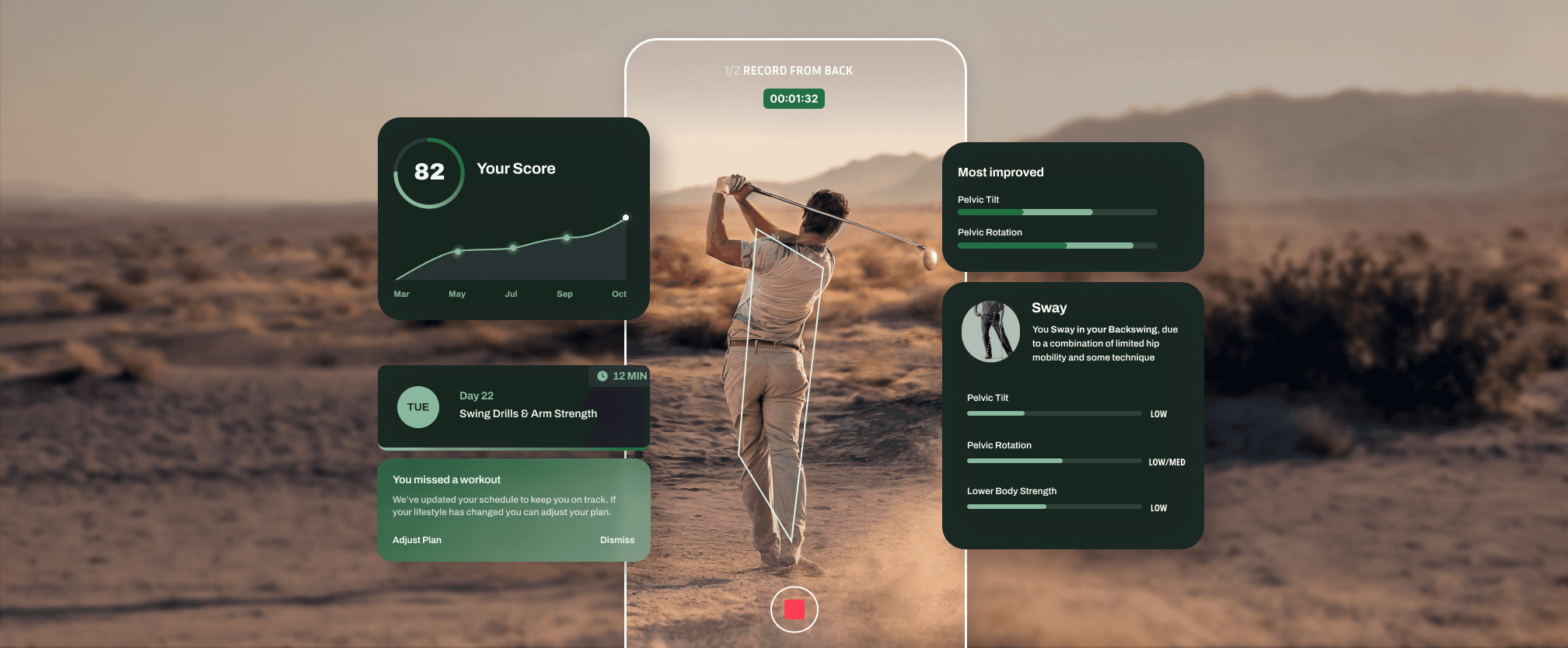
With the power of AI, these screens bring the interplay between a golfer’s technique and mobility to life. The product identifies common swing characteristics they’ve displayed during their swing analysis, and connects it to mobility data captured in the physical assessments.
This tells golfers how and when specific aspects of their strength and mobility impact their golf swing — or not, in the event that a problem with their swing is simply a matter of learning different technique.
Understandably, the golfers we tested with told us this part of the product was the most uniquely valuable feature. However, this was not a given.
Most golf training has historically focused on technique, with golf often seen as more mental over physical. A huge question we had around the value of these reports was whether or not golfers would become frustrated by the app’s focus on the body versus jumping straight into tips and drills to improve their swing.
Our research validated that the modern golfer is deeply interested in physiology. Aside from concept testing, this interest was reflected in the survey results, where golfers reported “gaining flexibility” as their top reason to pursue a golf fitness program.
Body-Swing Reports
The ability to analyze a golfer’s performance is one half of TPI’s core offering, so we had to learn the ins-and-outs of how TPI professionals analyze golfers and bring that experience into something palm-size that was equally compelling.

While the Results Dashboard is enough to draw most golfers in, we want to make sure they stay engaged with the app long-term. One of the ways we do that is by ensuring they can track their improvement quickly and easily.
The app assigns golfers an overall score (called the “Body Swing Score”), so that they can track holistic improvement at-a-glance instead of trying to keep tabs on every body metric.
The Body Swing Score allows us to gamify the product -- adding in a dose of competition by showing golfers how they compare to each other and to professionals.
Score Details
The ability to analyze a golfer’s performance is one half of TPI’s core offering, so we had to learn the ins-and-outs of how TPI professionals analyze golfers and bring that experience into something palm-size that was equally compelling.

Key Research Questions
Do golfers understand the scores, metrics, and other information? Are they meaningful?
What do golfers want to do with this information?
Improvement Plan
The other half of TPI’s core value proposition is that it can actually help golfers improve via exercises, stretches and drills. We created an improvement plan feature that could serve as a golfer’s coach, fitness instructor and physical therapist.

The Improvement Plan also elevates this experience from a one-time-use product to a lifetime use one.
This feature will use all of the data gathered thus far and create a personalized regimen for each golfer to improve their golf game via select exercises, stretches, and swing drills.
The golfer works in tandem with the AI engine to find the right balance between guidance and self-input, so that they see real improvements over their preferred time period. As we learned in our initial user interviews (as well as from our own lives), consistency is key when seeking physiological results, and its also the biggest pain point all-around.
As this feature is developed -- and after -- it will likely become the product’s team focus, as there are infinite possibilities to make it more personalized, impactful and gamified.
Key Research Questions
Do golfers expect a plan like this based on their experience with the product thus far?
Is the plan particularly helpful or useful compared to other fitness plans?
How often would golfers want or be able to engage with exercises, stretches and drills assigned to them?
Does the interplay between the performance feature and the plan make golfers feel more or less motivated to engage?
Overview of core features
Assessment
Onboarding Questionnaire
Learn about a golfer’s history, ability and preferences
Benchmark Exercises
Guide the golfer to perform a series of movements that provide key information about their mobility
Swing Capture
Have the golfer film themselves performing a golf swing
Analysis
Body Swing Score
Assign a numerical value that reflects the golfer’s ability based on a holistic analysis of their assessment data
Mobility Metrics
Show quantitative information about the golfer’s performance in the benchmark exercises
Swing Characteristics
Show when and if a golfer is displaying certain swing characteristics and information about them
Instruction
Improvement Plan
Provide a data-based regimen containing exercises, stretches and drills that will allow the golfer to improve
Guided Workout
Guide golfers through their workouts in lieu of an in-person coach
Progress & Trends
Display progress showing the golfer’s behavioral trends and track their progress in both physical & technical abilities
Research Findings
We synthesized & analyzed our user testing sessions to identify both overarching, key findings and ones that allowed us to tweak and iterate on each feature.
Golfers are more than ready for this product
100% of golfers who participated in concept testing said they would use the app if it was available today.
To reflect that within a wider market lens, 80% of golfers we surveyed expressed interest in golf fitness training programs.
This product offers a unique value proposition to golfers that doesn’t exist elsewhere
Both in the survey and in user testing sessions, we found that there are no products that offer the core value props our concept does:
An approach to golf training that holistically considers both technique and mobility
A science-backed analysis of a golfer’s physiological condition
A personalized training plan that can measure and track progress
Golfers will invest their time and money in this product
Over half (52.6%) of survey respondents said they were comfortable paying for a golf performance program by Titleist without having seen or heard anything about the program itself.
Meanwhile, golfers who participated in user testing sessions expected to pay about $20/month for the product shown in the prototype. With additional human touch points in certain areas, several golfers expected to spend up to $50-80/month.
Business Impact
As mentioned above in the outcomes, this 9-week discovery project lead to a 3+ year-long, $10m+ engagement with Titleist to design and build this product.
Based on predicted adoption rates and what the market is willing to pay, we estimate that this product will grow the current TPI business by 10-20x, at a magnitude of $50-100m.